
Pin Up Poker
"Over the past 8 years of observing digital gaming trends, we have seen countless players rush into real-money games without understanding the basics. The most responsible approach to poker online is education first: master the rules, utilize free formats, and always prioritize compliance with local laws over quick action."
Nadiya Farzana Haque, Chief Editor, iGaming Bangladesh.
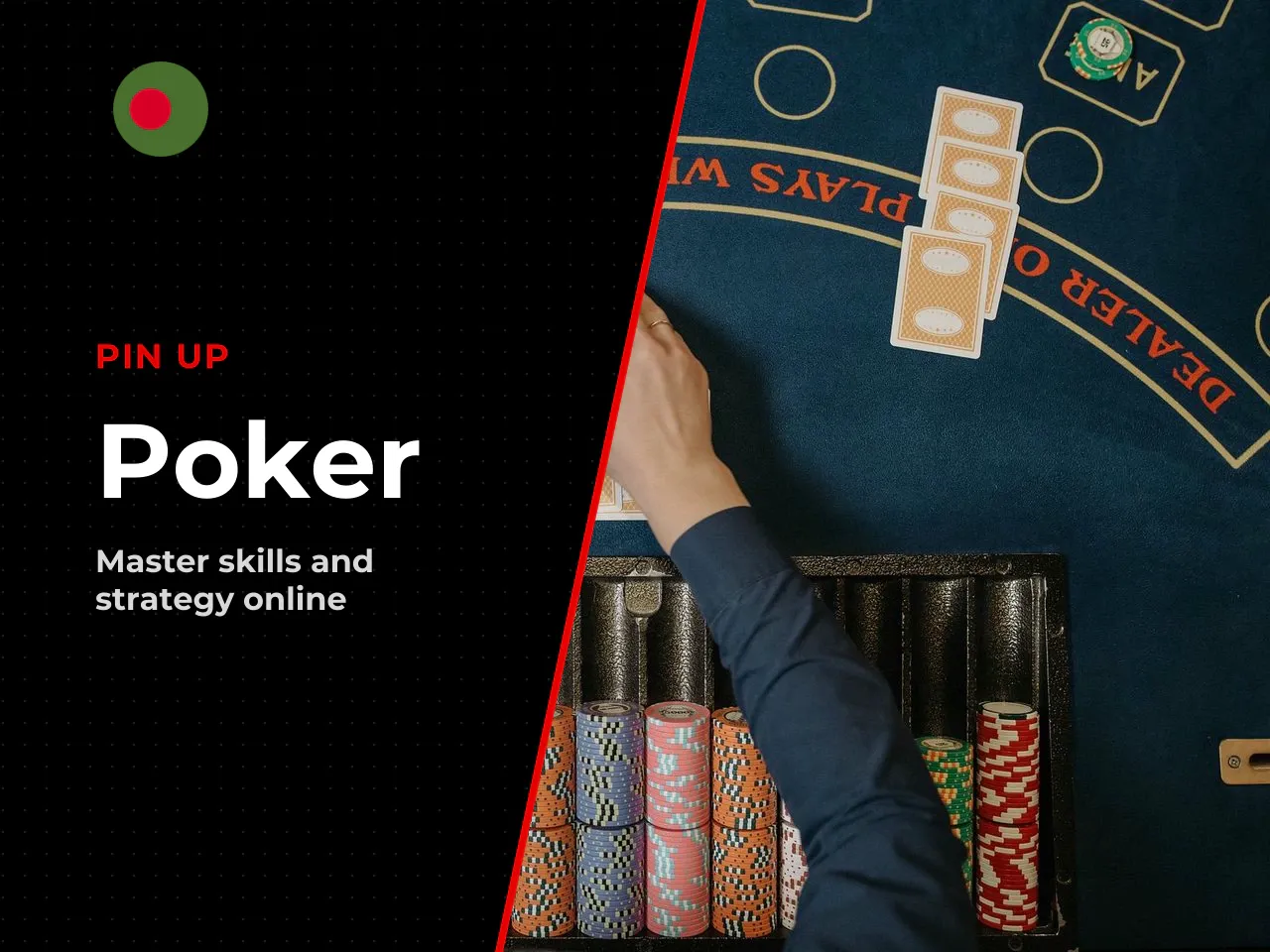
Poker is one of the few card games where your decisions genuinely matter more than your luck — at least over time. That distinction alone makes it worth understanding properly before you sit down at any table, virtual or otherwise.
In a market where responsible gaming should come before everything else, learning the mechanics through a structured, risk-free approach is simply the smartest first step. This guide covers hand rankings, betting flow, strategy tips, and step-by-step instructions for launching your first session. No pressure, no aggressive sales pitch — just the information you actually need.
Disclaimer: 18+ only. Information provided is for educational purposes. Always verify local jurisdiction laws regarding online platforms. We do not promote unregulated gambling.
What Poker Online Is and Why Players Choose It
Online poker is the digital adaptation of traditional card mechanics. Instead of a physical table, you play through a browser or dedicated software. Players choose this format because it removes geographical barriers, automates complex calculations, and provides instant access to games at any hour.
The global online poker market is projected to grow at approximately 12% annually through 2030, driven largely by the demand for thousands of weekly hands needed for genuine skill development — Navigating the Digital Felt: A Comprehensive Analysis of Online Poker Accessibility, Learning Pathways, and Strategic Foundations, 2024. Browser-based access significantly lowers the startup effort. You can play poker without downloading heavy casino clients. Between the convenience of a browser tab and the depth of a full desktop client, poker players are drawn to the flexibility that digital platforms offer.
And honestly? That flexibility is the main reason the format keeps growing.

Free Poker, Casino Tables and Browser Access
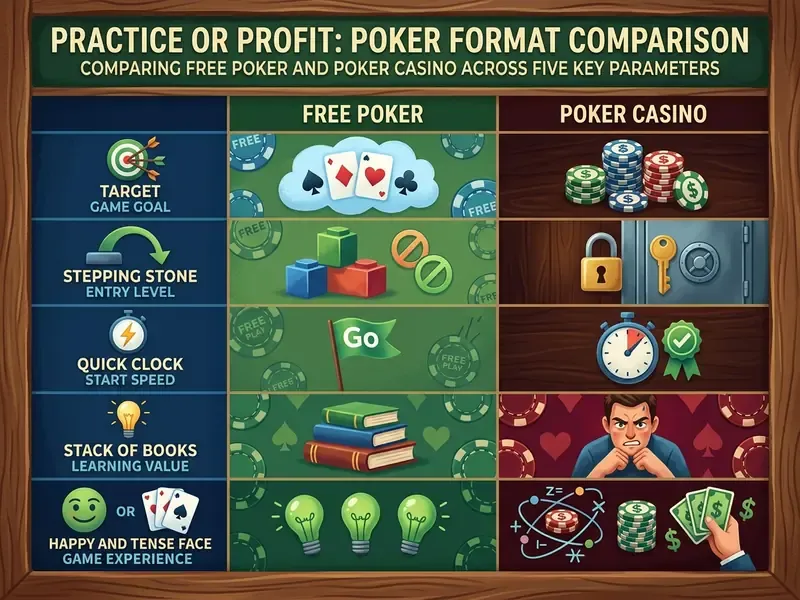
Free poker serves as a risk-free entry format where users play with virtual currency. No real money involved — no financial pressure at all. This mode allows anyone to launch an online poker game directly from a browser, bypassing complex account funding procedures entirely.
Moving to full poker casino tables introduces real monetary stakes and typically requires heavier software, identity verification, and a funded account. For your first session — whether you are looking to get access or start right now — browser-based free play is the most secure gateway. Start there. The casino tables will still be waiting later.

Who Online Poker Is Best For
This format works best for analytically-minded adults seeking strategic entertainment — people who prefer skill-based decisions over pure chance. New poker players benefit immensely from play poker setups designed purely for practice, where rule comprehension is the sole objective. No money on the line means no anxiety clouding your learning.
Conversely, experienced individuals often gravitate toward competitive tables expecting a higher level of psychological challenge. The crucial distinction? Recognizing whether you rely on free modes for learning or casino formats for risk-based entertainment. Both are valid. They just serve different purposes.
How Poker Compares to Sports Betting and Casino Slots
One question many new players ask is whether poker is truly a skill-based activity or simply another form of gambling. Fair question. The answer lies in the structure.
In poker, you compete directly against other players, making decisions rooted in probability, psychology, and position. Sports betting involves analyzing external events — team form, injuries, weather — where the bettor has no influence on the outcome itself. Casino slots, by contrast, are driven entirely by a Random Number Generator with a fixed house edge, offering zero strategic input from the player.
Poker occupies a unique middle ground. Short-term luck exists in any single hand, but over thousands of hands, skill-based decisions dominate the results. This is precisely why many analytically-minded users who enjoy iGaming content find poker the most intellectually rewarding format among all gaming categories.
How to Play Poker: The Basics Each Player Should Know
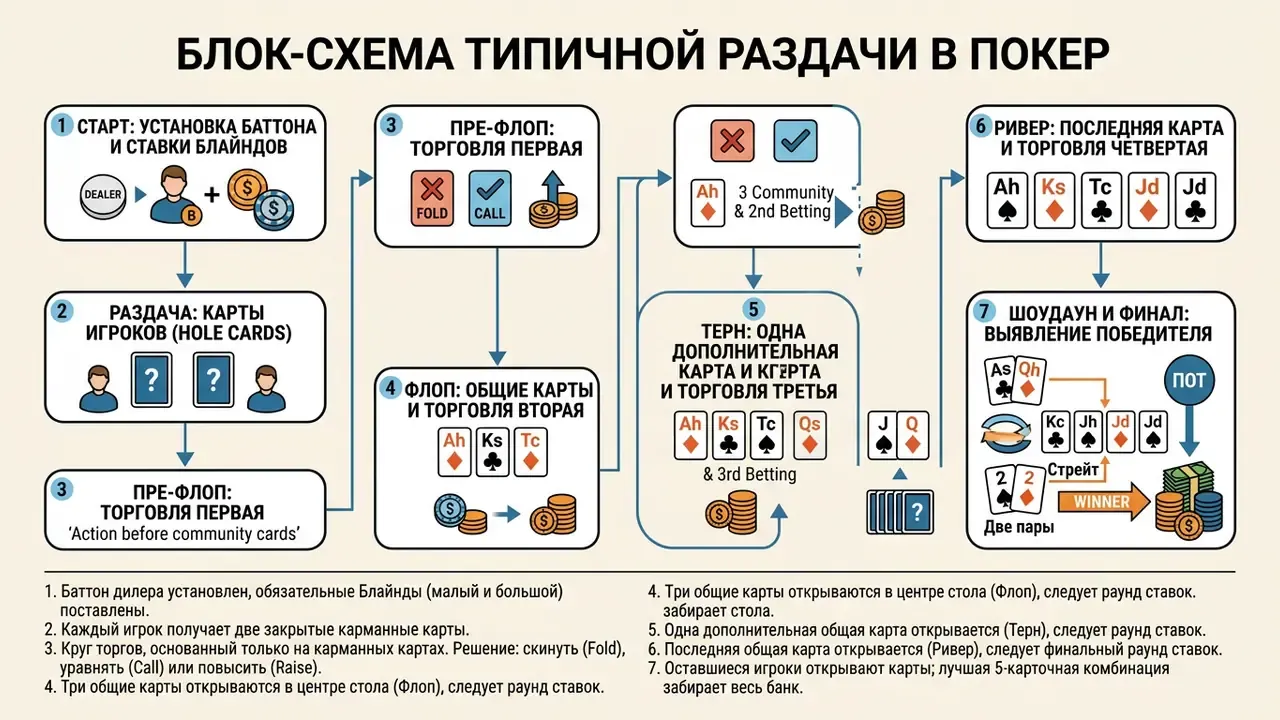
Every round of a poker game revolves around receiving hidden cards, participating in betting rounds, and aiming to present the strongest combination at the showdown. Each player must understand that success relies equally on mathematical probability and the calculated risks taken against opponents.
Before you play poker online securely, it is mandatory to grasp the hierarchy of a hand, the function of the card deck, and how the dealer organizes the action. Learning these basics protects newcomers from fundamental, costly errors — the kind that feel obvious in hindsight but sting in the moment.
Cards, Hand Strength and the Role of the Dealer
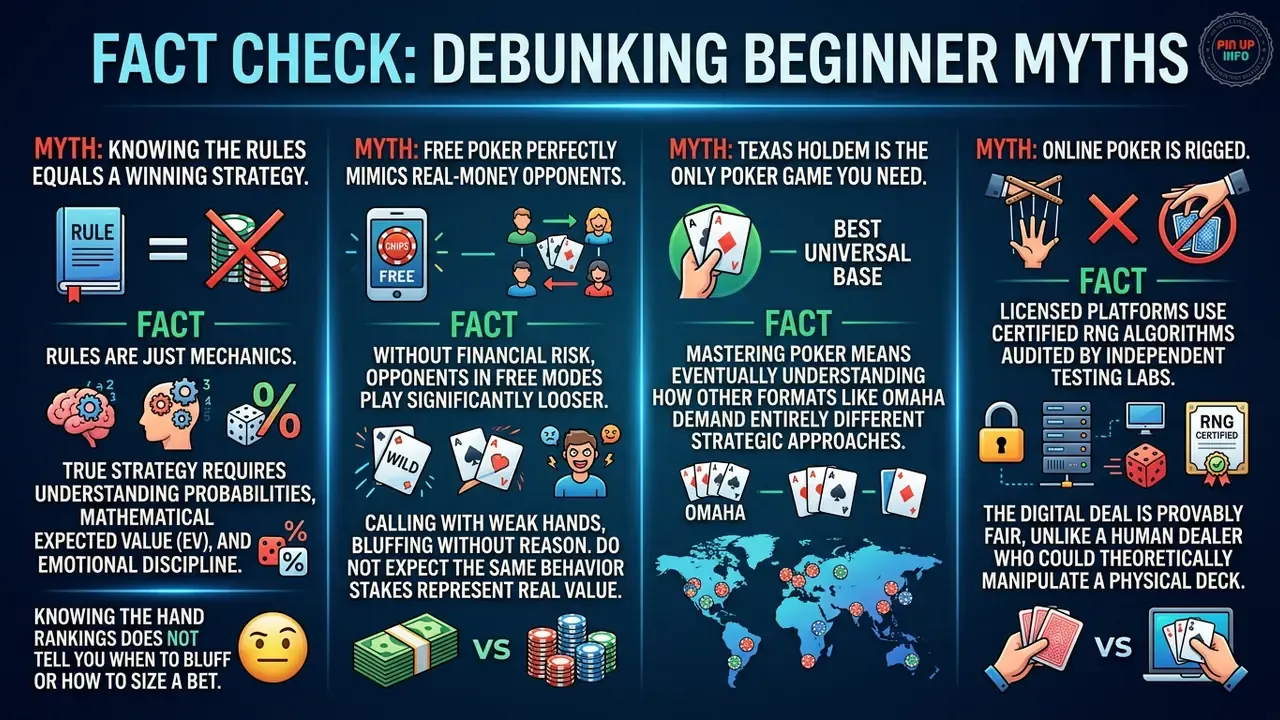
A standard digital session uses a traditional 52-card deck without jokers, where the automated dealer handles all shuffling and distribution. The software uses a certified Random Number Generator (RNG) to shuffle the virtual deck before every hand, ensuring that card distribution is fair and unpredictable. So no — the deal is not "rigged." That concern comes up constantly, and it is worth addressing directly.
The foundation of the game is hand strength, ranked from a simple High Card up to the unbeatable Royal Flush. The software algorithm objectively evaluates what cards each player has at the showdown, instantly declaring the winner. Because the digital dealer operates deterministically, players can focus entirely on comparing their hand strength against the board rather than worrying about procedural fairness.
Poker Hand Rankings: From Highest to Lowest
Understanding which hands beat which is the single most important piece of knowledge for any new player. Below is the complete hierarchy used in Texas Holdem and most other standard poker formats, ranked from strongest to weakest:
- Royal Flush — A, K, Q, J, 10 all of the same suit. The rarest and highest possible hand.
- Straight Flush — Five cards in sequence, all of the same suit. Example: 9♥ 8♥ 7♥ 6♥ 5♥.
- Four of a Kind — Four cards of the same rank plus any fifth card. Example: Q♠ Q♥ Q♦ Q♣ 4♠.
- Full House — Three cards of one rank and two cards of another. Example: J♣ J♦ J♠ 5♥ 5♦.
- Flush — Five cards of the same suit, not in sequence. Example: K♠ 10♠ 7♠ 4♠ 2♠.
- Straight — Five cards in sequence from mixed suits. Example: 9♥ 8♣ 7♦ 6♠ 5♣.
- Three of a Kind — Three cards of the same rank with two unrelated cards. Example: 8♣ 8♦ 8♠ K♥ 3♦.
- Two Pair — Two different pairs plus a fifth card. Example: A♠ A♦ 6♣ 6♥ 9♠.
- One Pair — A single pair with three unrelated cards. Example: 10♥ 10♣ K♠ 7♦ 2♣.
- High Card — No matching combination; the highest individual card plays. Example: A♠ J♦ 8♣ 5♥ 2♠.
When two players hold the same hand type, the winner is determined by comparing the highest relevant cards — these are called kickers. For instance, if both players have one pair of nines, the player has the higher remaining card wins the pot. On online platforms the software performs this comparison instantly at showdown, so you always receive the correct result. No arguments, no ambiguity.
Betting Flow at the Table
Betting flow is the structured, turn-by-turn sequence where players decide to commit chips, hold their position, or fold their cards. Action moves clockwise around the table. At each turn, a user can check (pass the action without wagering), bet (initiate a wager), call (match an existing bet), or raise (increase the bet).
The betting round concludes only when all active members have exactly matched the highest wager or folded. How you play and hold your chips during these intervals dictates your entire table survival strategy. Rushing through this sequence is one of the fastest ways to lose — more on that in the strategy section below.
Texas Holdem as the Main Online Poker Format
Texas Holdem is the undisputed foundation of digital card gaming. Its mechanics balance simplicity of access with deep strategic complexity in a way that no other variant quite matches. By separating the game into just two private cards and five shared ones, poker texas formats minimize the initial cognitive load for beginners.
The industry standardizes around holdem, making it the default option on nearly every platform worldwide. For anyone engaging in free poker or educational play, this mode is the absolute starting point. Everything else builds on top of it.
How Texas Holdem Differs from Other Poker Games
Texas Holdem differs from older formats by requiring players to track only two private cards instead of five or seven. That sounds like a small detail, but it changes everything.
In Seven-Card Stud, players receive up to seven individual cards with no community board at all. That forces them to memorize more hidden variables and face steeper learning curves. In Five-Card Draw, each player starts with five private cards and may replace some during the hand, raising the starting hand load compared to Holdem's clean two-card start. This structural simplicity is exactly why platforms overwhelmingly promote this poker game online for new users. Fewer variables at the start means faster comprehension — and fewer expensive mistakes.
When to Start with Holdem and When to Try Other Games
Beginners should focus entirely on Holdem for their first few months until betting flow and positional awareness become automatic. Only after consistently demonstrating discipline during initial play sessions should you explore complex alternative poker games like Omaha or Stud.
Jumping into varied formats too early dilutes learning. The strategic habits built in standard poker games online do not always transfer seamlessly — Omaha, for instance, uses four hole cards instead of two, which completely changes hand evaluation. Master one format first. Then branch out.
How to Choose Between Free Poker and Poker Casino Play
Disclaimer: This information is general in nature and does not replace professional advice. Always verify the legislation in your jurisdiction before participating in real-money games. In regions where gambling is restricted, free social poker with virtual chips typically falls outside gambling regulations, but real-money play may carry legal and financial risks including payment blocks.
disclaimer

Choosing between these modes comes down to two questions: what is your risk tolerance, and what is your primary goal — education or real-value competition?
Poker online free environments use simulated chips, maximizing learning opportunities without exposing your bankroll to danger. Poker casino formats tie real-world value to every table decision, drastically altering the psychological weight of betting. Your choice should reflect your current understanding of the rules and local responsible gaming limits.
Worth noting: research shows that participation in internet gambling does not by itself predict problem gambling severity when demographic variables are controlled — Navigating the Digital Felt: A Comprehensive Analysis of Online Poker Accessibility, Learning Pathways, and Strategic Foundations, 2024. Context matters more than the format itself.
Benefits of Playing Poker Online Free First
Playing for free completely eliminates the destructive variance that ruins beginner confidence during early skill development. Digital platforms allow users to experience up to 500 hands per hour in fast-fold formats compared to just 30 hands in live games — Navigating the Digital Felt: A Comprehensive Analysis of Online Poker Accessibility, Learning Pathways, and Strategic Foundations, 2024. That massive repetition helps any new player learn interface layouts and hand recognition safely.
A first free-mode session provides three concrete benefits: you map every action button (Bet, Call, Raise, Fold), you learn the actual pace of the timer bank, and you get used to animations and visual effects without the stress of losing money. We always recommend starting here to ensure a solid foundation before any money enters the conversation.
"In our editorial testing, newcomers who used a free-to-play sandbox first showed significantly faster rule comprehension and noticeably fewer basic errors when they eventually moved to real-money formats."
Editorial Observation, iGaming portal structure analysis.
 completely alters opponent behavior, chip value, and personal emotional regulation.](/media/pinupbd_com_media_text_section_22_media_image_ea3388c5_44d4_4d85_9466_c6243b9bf8d6_97faf7fa07.webp)
What Changes When You Move to Casino Tables
Transitioning to a real-money poker casino table completely alters opponent behavior, chip value, and personal emotional regulation. Because chips now represent actual financial risk, bluffing gains mathematical weight. Players face significant pressure over every decision — even small ones.
Interestingly, a contemporary study noted that the median two-year total deposit amount for moderate engagement was just €176.4 — Navigating the Digital Felt: A Comprehensive Analysis of Online Poker Accessibility, Learning Pathways, and Strategic Foundations, 2024 — showing that cautious betting is standard behavior among most poker players, not high-stakes excess. You must adjust to an environment where every mistake carries a literal cost: opponents fold more carefully, bluffs face genuine resistance, and the psychological gap between free play and real money becomes immediately apparent. It is, frankly, a different game.

A Note on Legal Considerations and Payment Risks
In many South Asian jurisdictions, including Bangladesh, gambling laws can be strict. Free social poker with virtual chips — where no money is wagered, won, or withdrawn — generally sits outside the legal definition of gambling. That is an important distinction.
However, if you decide to play for real money on international platforms, be aware of potential risks. Local banks may block transactions to gambling sites. Cryptocurrency alternatives carry their own regulatory complexity. Penalties for illegal gambling activity vary by region and can be severe.
Always research your local laws before depositing funds. When in doubt, stick with free play: it delivers the full educational experience without any legal or financial exposure. The learning value is identical. Only the stakes differ.
How to Start an Online Poker Game Step by Step
Disclaimer: Strategies and tips in this section are educational. Real-money play involves financial risk. 18+.
warning
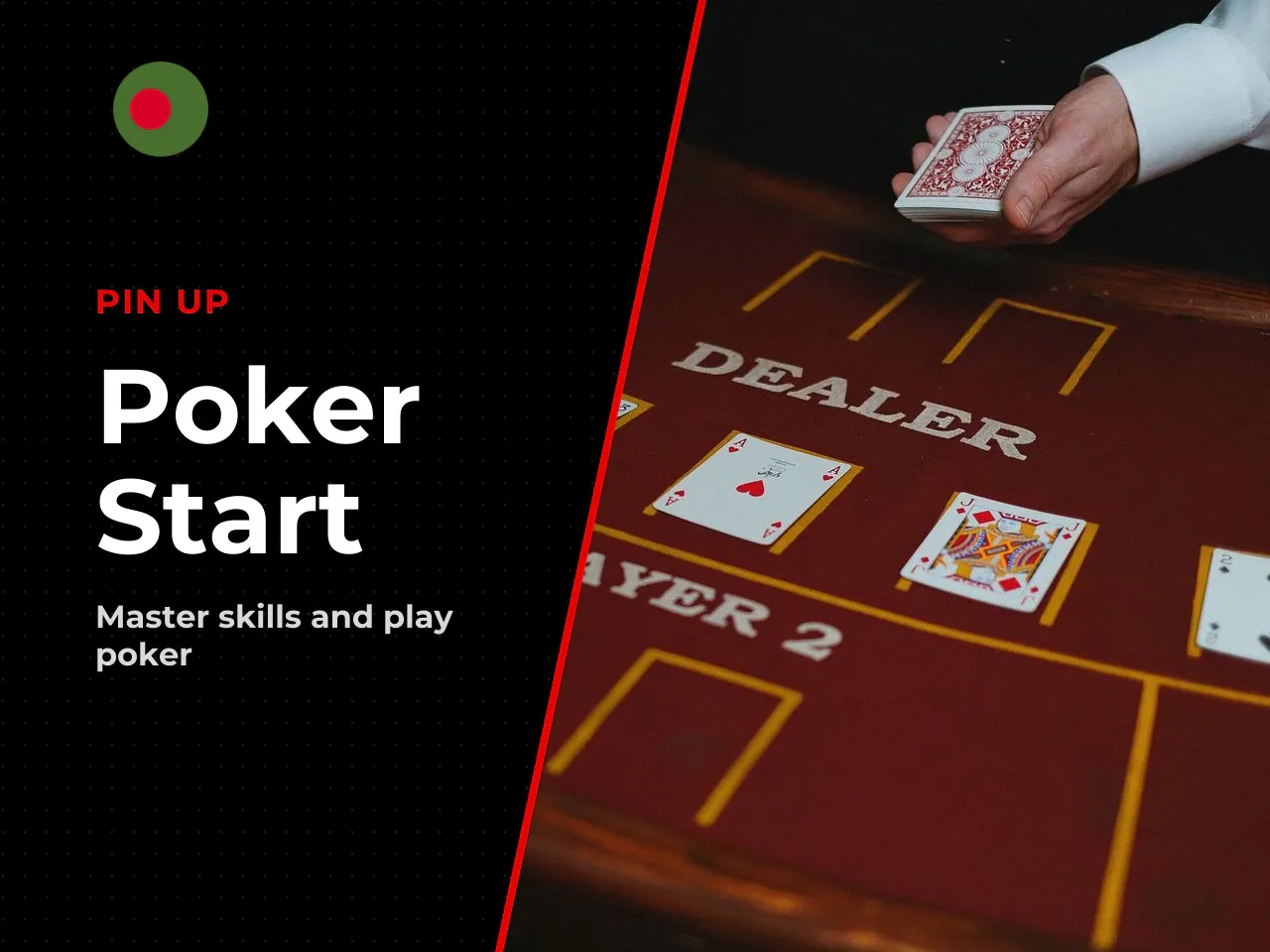
Starting your journey requires selecting a trustworthy, locally compliant platform, verifying the playing mode, and testing the interface. The moment you get access, your first action should be locating the free-to-play section to start without pressure. Finding a safe online poker game is about verifying software reliability — not rushing into action right now.
Below is a practical step-by-step checklist to guide you from zero to your first hand:
- Select a reputable platform. Look for sites with visible licensing information, published RNG certification, and a clear play-money section. Avoid platforms that require a deposit before you can even browse the lobby.
- Open the site in your browser. Most modern platforms run entirely in-browser — no download needed. Confirm the site loads correctly and buttons respond without delay.
- Navigate to the free play / play money section. Do not enter any payment details at this stage. Your only goal is learning.
- Choose Texas Holdem as your game type. Select a low-speed cash table with play-money chips, not a tournament.
- Sit down and verify the interface. Locate the dealer button, confirm your hole cards are visible, and test each action button (Fold, Check, Call, Raise).
- Play your first 20–30 hands conservatively. Focus on observing the betting flow and recognizing hand rankings. Do not worry about winning — focus on understanding.
- Review and repeat. After your session, mentally note which hands confused you and look them up in the hand rankings section above.
Choose a Game, Table and Playing Mode
Your selection must align directly with your current experience level. Novices should strictly choose low-speed, play-money cash tables. The playing mode dictates the pace: tournaments lock you in for extended periods, whereas cash games let you leave at any time.
Carefully evaluating the poker games online available on your chosen site prevents the anxiety of sitting at a mathematically overwhelming table. A quick tip: if the average pot size at a table looks intimidatingly large, you are probably at the wrong table for your skill level. Move down. There is no shame in it.
What to Check Before Your First Hand
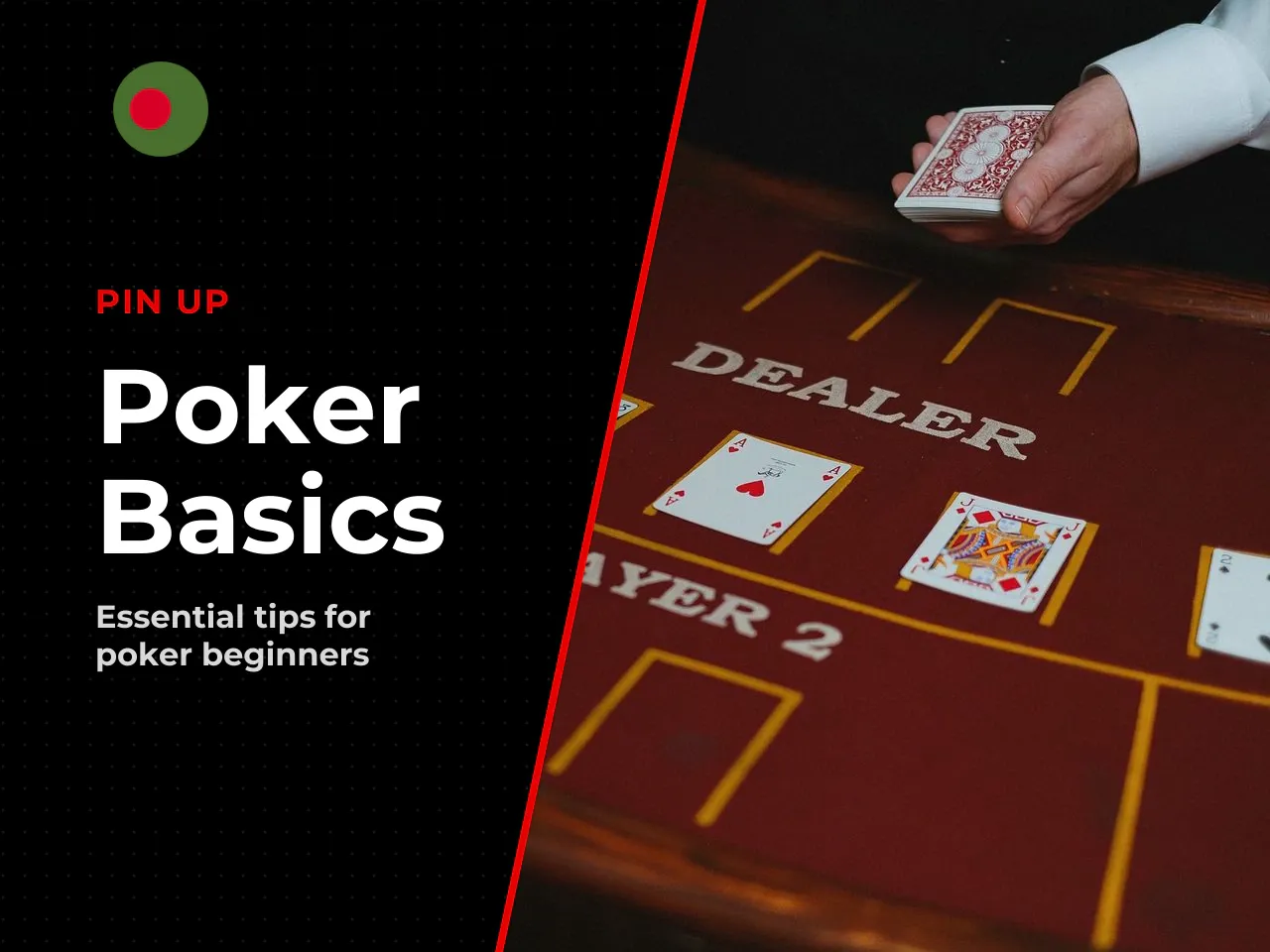
Before the automated dealer distributes cards, locate the dealer button and ensure the action buttons (Bet/Call/Raise) respond instantly. Interface lag can cause unintended actions — industry usability standards recommend software response times well below one second to prevent critical betting errors.
You should also confirm that the pot size display and your hole cards are clearly visible. Check that the table layout shows the community card area, player positions, and chip stacks in an uncluttered format. If anything feels confusing or cluttered, try a different table or platform before committing to a full session.
How to Play Online Poker with Friends
Many free platforms allow you to create private rooms where only invited players can join. The process is straightforward: create a table, select your format (cash or sit-and-go), set the number of seats — typically up to 9 — and share an invite link with your friends.
They join directly in their browser without downloading software or creating a full account. Private games are an excellent way to practice in a comfortable, low-pressure environment before facing unknown opponents. If your friends are offline, some platforms also offer community matchmaking where you can find casual games at any time of day. Either way, the social element makes learning considerably more enjoyable.
Basic Poker Strategy for New Players
Disclaimer: This section is educational. Real-money play involves financial risk. 18+.
warning
A fundamental strategy for a new player strictly involves tight hand selection, playing in position, and avoiding unnecessary risks. While you learn the mechanics, prioritize folding over aggressive playing to protect your virtual or real stack. Betting requires mathematical justification, not emotion. Every decision should be evaluated based on long-term profitability — a concept sometimes called Game Theory Optimal (GTO) thinking.
That might sound intimidating. It is not. At its core, GTO simply means: make the decision that would be profitable if you repeated it thousands of times. Forget about any single hand.

Starting Hand Discipline and Simple Decisions
Discipline dictates that beginners should consistently play only premium pocket pairs (AA, KK, QQ) and strong broadways (AK, AQ), instantly folding weak hands. Rejecting unsuited trash cards like 7-2 or 8-3 without hesitation is the absolute core of early survival. This conservative approach limits post-flop complications and makes your decisions regarding the hand significantly simpler.
As you build confidence, you can gradually expand your range to include suited connectors — for example, 9♣ 10♣ or 7♥ 8♥. These hands have straight and flush potential, but they require careful play: enter the pot cheaply from late position, and fold immediately if the flop does not connect. Suited connectors are money makers for experienced poker players, but they can drain a beginner's stack if played recklessly from early position. Patience is, quite literally, the most profitable skill at this stage.
Common Mistakes at the Online Table
The most frequent error new poker players commit is entering too many pots with weak cards while sitting out of position. Without positional advantage, you act before your opponents and make every post-flop decision with less information — PokerStrategy.com, 2024.
Furthermore, inconsistent bet sizing — either betting too little to protect a hand or too much on a bluff — destroys long-term win rates. Your bet size should always relate to the pot: a standard continuation bet of 50–75% of the pot pressures weak hands while keeping your risk manageable — TwoPlusTwo Forums, Bet Sizing 101, 2023.
Clicking "play" too quickly due to digital timers without calculating pot odds is a direct path to failure at any table. If you do not have time to think through the math, it is always better to fold than to guess. Guessing feels like action. Folding feels like giving up. But over hundreds of hands, disciplined folding is what separates winning poker players from losing ones.
Bankroll Awareness: The Skill Nobody Talks About
Even in free poker, developing bankroll awareness matters. Here is why: if you treat play-money chips as worthless, you build terrible habits. You call every hand, chase every draw, and learn nothing about risk management.
Instead, set yourself a mental budget even in free mode. Decide that your starting stack of, say, 10,000 play chips is your "bankroll" for the session. If you lose it, stop. Review what went wrong. This simple exercise trains the same discipline that real-money poker demands. Professional players typically recommend never risking more than 5% of your total bankroll on a single table — and that principle applies whether the chips are real or virtual.
The goal is not to win every session. The goal is to make better decisions than you did yesterday. That is what poker is, really — a long game of incremental improvement.
FAQ About Poker Online and Free Play
Yes. Utilizing play-money software is universally recognized as the safest, most efficient method to learn the rules. Because the software handles up to 500 hands an hour, players develop pattern recognition without any financial pressure. Online poker schools, coaching platforms, and courses by professional players have democratized strategic knowledge that was once accessible only through personal mentorship — *Navigating the Digital Felt: A Comprehensive Analysis of Online Poker Accessibility, Learning Pathways, and Strategic Foundations, 2024.* This environment accelerates game understanding faster than offline environments ever could.
Yes, it is the optimal starting point because it requires processing only two private cards, minimizing early cognitive overload. The global community uses this exact format to teach fundamental concepts like position, pot odds, and opponent analysis. Other poker games rely on the foundational skills built primarily through Texas Holdem — so learning it first gives you a transferable base regardless of where you go next.
The highest possible hand in Texas Holdem is the **Royal Flush**: Ace, King, Queen, Jack, and Ten, all of the same suit. The odds of being dealt a Royal Flush are roughly 1 in 650,000 hands. If two players both hold a Royal Flush — which can technically happen using community cards — they split the pot equally since all Royal Flushes are identical in value. In practical terms, most poker players will never see one in their lifetime. But knowing it exists at the top of the hierarchy helps you understand the full ranking scale.
Digital platforms automate complex table management, instantly calculating pot sizes, shuffling, and highlighting potential winning combinations. This browser access eliminates the intimidation factor of facing live opponents and dealing with physical chips. Consequently, starting a free session online completely removes both the social anxiety and the mathematical friction of traditional offline card rooms. You do not need to know how to physically shuffle, count chips, or manage the pot — the software handles all of it.
Yes. Many browser-based platforms offer private room functionality. You create a table, choose your preferred format, and share an invite link. Your friends join through the link directly in their browser — no downloads, no accounts, no deposits. Games typically support up to 9 players per table, making it easy to organize a casual session any evening of the week. *Last updated: June 2026. Content reviewed by the iGaming Bangladesh editorial team.*